How to Choose Eco Friendly Shipping Boxes
Choosing eco friendly shipping boxes is not just a matter of picking brown cardboard. The right choice protects products, limits unnecessary material, and suits the way your business packs and ships orders. A small box that fits a ceramic mug, for example, may need less void fill than an oversized carton. But it still needs to withstand handling and transit.
When comparing options, check recycled content, box strength, material weight, and local recycling guidance. Packaging labels can be confusing. “Recyclable” does not always mean a box will be accepted in every community, especially if it has coatings, tape, or other materials attached. Details matter. Architect and sustainability thinker William McDonough offers a useful reminder: “Being less bad is not being good.” Applied to shipping, that idea encourages businesses to look beyond a single green claim and consider the box’s full use.
This guide explains how to choose eco friendly shipping boxes by weighing practical performance against environmental considerations. It covers sizing, recycled and responsibly sourced materials, durability, and supplier questions worth asking. It also recognizes trade-offs: a lightweight box may use fewer resources, but it may not be the right option for a fragile or heavy product. There is no perfect box for every shipment. The goal is to choose packaging that protects the item without excess, and to review the choice as products, shipping needs, and available recycling options change. A little testing helps. A dented corner or a layer of unnecessary filler can reveal what needs improvement.
Identify Your Shipping Needs and Packaging Requirements
Start with the item, not the box. Measure its length, width, and height, then note its weight and any parts that could bend, leak, or break. Allow room for protective padding, but avoid a large empty space that lets the item shift. A snug fit can reduce excess material and help keep the package stable during handling.
Tips: Measure the packed item, too. Check whether several products ship together, and note any storage or stacking limits. Small details matter.
Next, consider the journey. A parcel traveling across a short local route may need different protection from one handled through several sorting points. Think about exposure to moisture, rough handling, and stacking pressure. Compare box sizes and material specifications, including recycled content and strength, rather than choosing by appearance alone. If possible, pack a sample and check whether it stays closed and protects the item after ordinary handling. This is not a perfect test, but it can reveal weak corners or too much unused space. Also consider how the box fits your packing process: an awkward size may slow packing or require extra filler. Record what works, then revisit the choice when products or shipping conditions change.
Compare Sustainable Box Materials and Their Environmental Impact
Choosing eco-friendly shipping boxes means comparing materials, protection, and disposal options. Recycled corrugated cardboard uses recovered fiber and can protect books or jars when its strength matches the shipment. However, recycled fibers shorten over time. A weak box may split, leading to damaged goods and another delivery. Small details matter.
New kraft or corrugated board can provide sturdy protection, but it relies more heavily on fresh fiber. Responsibly sourced paper may reduce pressure on forests, though sourcing claims alone do not reveal a box’s full impact.
Molded-pulp inserts are often recyclable with paper, depending on local facilities. Reusable plastic totes can avoid repeated single-use boxes, but only when return trips happen often enough to justify their production and transport. It depends.
Tips: Match box size to the item to avoid excess material and shipping weight. Check whether local recycling accepts coated or heavily printed board. Choose simple paper tape and remove plastic liners when possible. A box that arrives intact is usually the better choice.
Choose the Right Box Size, Strength, and Protective Features
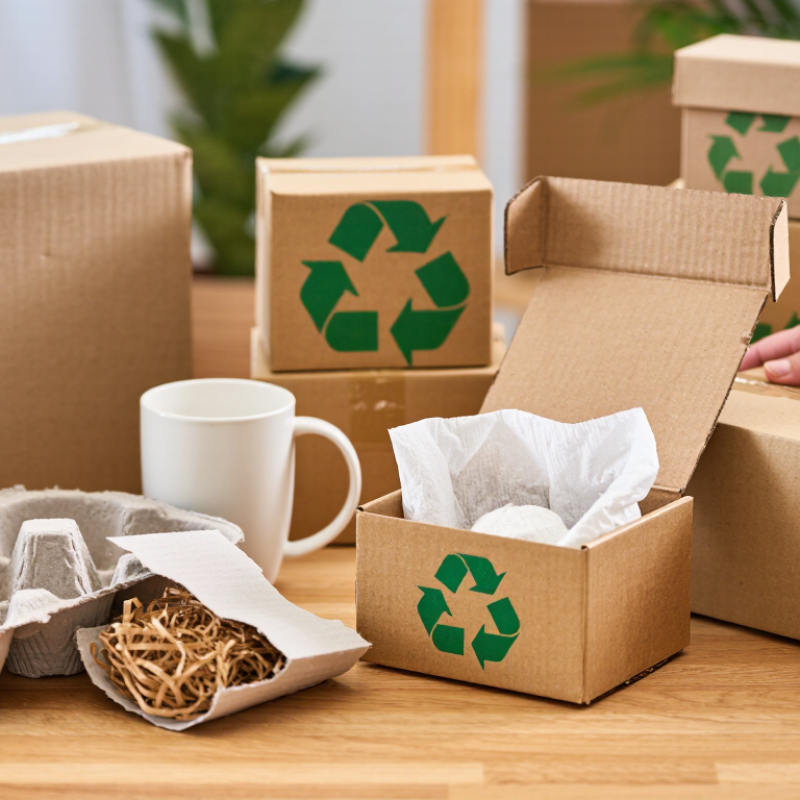
Choosing the right box size is one of the simplest ways to reduce packaging waste. Measure the item, including any protective wrap, then allow only enough room for cushioning. A box that is too large may need extra fill and can let products shift during transit. Small gaps matter. Try packing a sample and gently tilting the closed box; if the item slides, adjust the size or add a suitable cushion.
Match box strength to the item’s weight, shape, and likely handling. Heavier goods or products with sharp edges may need stronger corrugated board, while light, sturdy items often need less. Check the box supplier’s load guidance rather than judging strength by appearance alone. Recycled content can be a useful choice, but the box still needs to arrive intact; damaged shipments can create more waste. There is no perfect specification for every parcel.
Protective features should solve a real risk. Paper pads or folded paper can cushion corners and limit movement, while a snug insert may protect a fragile item with less filler. Test the packed box with a short drop onto a firm surface, using a sample rather than a sale-ready product. That test is imperfect. Still, it can reveal loose packing or weak corners before a larger batch is shipped.
How to Choose Eco Friendly Shipping Boxes - Choose the Right Box Size, Strength, and Protective Features
| Items Being Shipped |
Example Inner Box Size |
Box Strength to Consider |
Protective Features |
Eco Friendly Choices |
| Paperback books or other compact, non-fragile items |
10 × 8 × 4 in (25 × 20 × 10 cm) |
Light-duty corrugated board may be suitable for a single, light item. Choose based on packed weight and shipping conditions. |
Use a close-fitting box; add a paper pad if there is room for movement. |
Choose a right-sized box made with recycled fiber where available. Avoid unnecessary void fill. |
| Folded clothing or soft goods |
12 × 10 × 4 in (30 × 25 × 10 cm) |
Light-duty board is often adequate for lightweight contents, provided the box is not overloaded or exposed to heavy stacking. |
Use a snug fit and a moisture-resistant inner wrap when needed. |
Use recyclable paper packaging where appropriate, and avoid adding a larger box solely for excess padding. |
| Small electronics with their own retail packaging |
12 × 10 × 8 in (30 × 25 × 20 cm) |
Consider single-wall corrugated board with an appropriate edge-crush rating for the shipment's weight and handling. |
Leave room for cushioning on all sides; immobilize the retail package to limit impact and movement. |
Use paper-based cushioning or reusable protection when suitable. Keep the outer box as small as protection allows. |
| Ceramic mug or another fragile item |
10 × 10 × 10 in (25 × 25 × 25 cm) |
Use a sturdy corrugated box selected for the packed weight and shipping route; consider double-wall board for heavier or higher-risk shipments. |
Protect the item individually, cushion all sides, and prevent contact with the box walls or other items. |
Use recyclable paper cushioning if it provides adequate protection. Avoid relying on minimal packaging for fragile contents. |
| Several items packed together |
16 × 12 × 10 in (41 × 30 × 25 cm) |
Choose board strength for the total packed weight, box dimensions, stacking, and transit conditions—not weight alone. |
Separate items that could strike each other; fill empty spaces and keep contents from shifting. |
Use dividers or paper-based void fill where effective, and avoid oversized boxes that require excess material. |
How to size and assess strength: Box dimensions shown are examples of internal dimensions. Measure the packed product and allow enough space for protective material without leaving excessive void space. An Edge Crush Test (ECT) rating measures board edge-crush resistance; it is not a direct maximum payload rating. Check the box specification and test the packed configuration for the actual shipping conditions. Recycling acceptance varies by location, and boxes should generally be kept clean and dry for recycling.
Verify Recyclability, Certifications, and Environmental Claims
When comparing eco-friendly shipping boxes, check what “recyclable” means in practice. A box may be technically recyclable but not accepted by local collection programs. Look for clear material details, such as corrugated cardboard, and check whether coatings, laminates, or attached labels complicate sorting. A quick test: can the box be flattened, and can tape be removed easily? Small details matter.
Certifications can help, but read the scope rather than trusting a logo alone. Check which material or process the certification covers, who issued it, and whether the claim applies to the whole box or only part of it. Ask for current documentation if the information is unclear. It is easy to miss this. A certificate may cover paper sourcing, not the finished package.
Be cautious with broad claims such as “green,” “earth-friendly,” or “sustainable.” They do not explain what changed or how impact was measured. More useful claims name a specific feature, such as recycled content, and state its percentage. Compare that figure with the box’s strength and size. A lighter box may reduce shipping weight, but it still needs to protect the contents. The trade-off is not always obvious. I would want evidence before treating a reassuring label as proof.
Evaluate Suppliers, Costs, and End-of-Life Options
How to Choose Eco Friendly Shipping Boxes
Evaluate Suppliers, Costs, and End-of-Life Options
A box is only as sustainable as its supply chain and local disposal route. Ask suppliers for recycled-content percentages, fiber sourcing details, box weight, and test results for crush resistance. Request comparable quotes using the same box size and order volume. A lighter box may reduce shipping costs, but not if it leads to crushed corners or replacement shipments. Check minimum order quantities, too; unused custom stock can erase expected savings.
End-of-life claims need local context. The U.S. Environmental Protection Agency estimated that 96.5% of corrugated boxes were recycled in 2018, a strong national figure, but not a guarantee for every community. The American Forest & Paper Association reported a U.S. paper recycling rate of 65% to 69% in 2023. These figures use different scopes and methods, so they are not directly interchangeable. Ask whether boxes use water-resistant coatings, laminates, or plastic windows that could complicate recycling. Simple fiber construction is often easier to sort.
Inspect the box yourself. Fold a sample, tape it, and check whether it stays rigid after a damp delivery day. Then ask the supplier for documentation supporting environmental claims, not just a green label. Compostable boxes can sound appealing, yet industrial composting access may be limited. That detail matters. Choose an end-of-life option customers can actually use, and be candid where local services vary.
How to Choose Eco-Friendly Shipping Boxes
Evaluate suppliers, costs, and end-of-life options.
End-of-life snapshot: In 2018, the U.S. recycling rate was 96.5% for corrugated boxes and 68.2% for all paper and paperboard. When evaluating suppliers, ask for evidence of recycled content, compare delivered costs, and check whether local recycling programs accept the box and any coatings or adhesives.
Sources: American Forest & Paper Association, 2018 corrugated recycling rate; U.S. Environmental Protection Agency, 2018 paper and paperboard recycling rate. Rates are U.S. figures and may not reflect local recycling access.